


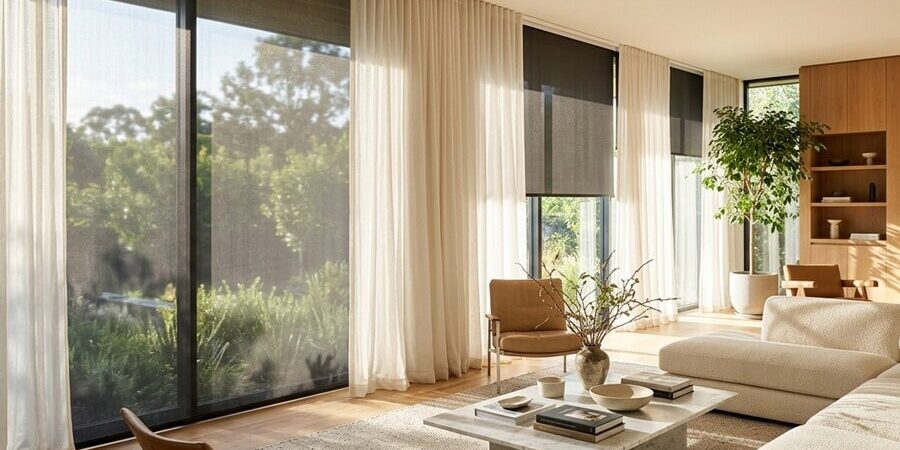
A south-facing room is the brightest in the house for most of the day, which is a selling point right up to the afternoon in July when the sofa is too hot to sit on. Blinds for south facing windows have two jobs that pull in opposite directions: hold back the harsh midday sun in summer, and let the low winter sun in when the room could use the warmth.
Why a South-Facing Room Behaves Differently
The height of the sun changes the whole picture. A solar elevation table for London on the Diamond Geezer blog shows the sun peaking at 62 degrees above the horizon on 21 June and only 15 degrees on 21 December. Manchester sits roughly two degrees lower on both dates, and timeanddate.com lists its midday sun at around 14 degrees in early December. Summer sun that high comes down through the glass at a steep angle and lands close to the window. The winter sun travels deep into the room instead, which is why glare on a screen or television is an autumn and winter problem as much as a summer one.
That is also why window coverings for bright rooms need to be adjustable rather than fixed in one setting. The same window needs very different handling in July and in January, and a covering that only works at full strength will be left open half the year.
Blocking Strong Sunlight Without Losing the Room
Blinds to block strong sunlight work best when they are matched to what the room is used for. A living room or home office usually wants a light-filtering fabric, which scatters the sun and keeps daylight in the space. A bedroom that faces south and gets woken by the sun at the wrong end of the day is a better match for a light-blocking fabric, because filtering alone will still let a bright glow through.
If heat is a bigger problem than glare, our guide to blinds to keep a room cool goes into reflective backings and fabric colour in more detail.
Low Winter Sun and the Glare It Brings
Low winter sun lands at eye level and straight across a screen, which makes it the glare you notice first. Lowering the covering for the hour or two when the sun is at its lowest, then raising it again once the sun has moved on, usually handles it without darkening the room for the rest of the day.
It is worth keeping the covering open when you can. Albion Windows points out that in autumn and winter the sun rises much lower, so light and warmth enter south-facing windows more easily, and that is free heat the room would otherwise go without.
Layering Light Control for Changing Conditions
Day and night blinds suit a room like this because they use alternating bands of light-filtering and more solid fabric, so the same blind can sit open, filtered or closed depending on the sun that day.
Whatever you choose, the best blinds for sunny rooms are the ones that still look right with the sun directly behind them. A swatch under the lights in a showroom tells you very little, so hold any sample up to your own glass at midday and again in the late afternoon before deciding.
Fitting Inside the Frame or Outside It
Where a blind sits matters more in a south-facing room than in a dim one, because any gap becomes a bright strip against a dark wall. Hanging a blind outside the recess, over the wall, covers the edges of the glass and stops light leaking round the sides, at the cost of a bulkier look.
Where there is enough depth, blinds that fit in window frame recesses sit flush and look tidy, though the measurement has to be exact, since a few millimetres of side gap shows up straight away in strong sun.
Aluminium Frames Get Hot, So Fixing Matters
Aluminium conducts heat well, so a frame that sits in direct sun for hours gets hot to the touch. That is worth remembering before choosing a fixing that depends on adhesive or plastic clips close to the frame.
Blinds for aluminium windows are normally fixed with metal screws rather than the wood screws usually supplied with a blind. Hunker’s installation guide recommends self-drilling screws, and tapping a centre punch into each mark first so the drill bit does not slip on the metal.
Choosing With Confidence
Stand in the room at the brightest point on a sunny day and notice what bothers you most: heat on your skin, glare on a screen, or a harsh patch of light across the floor. That one observation narrows the choice of fabric faster than any list of options.
If you need professional advice on a particular window, we can look at the glass, the frame and the way the sun reaches the room before recommending anything.
It is also worth deciding in autumn or early spring if you can, when the sun is low enough to show the glare problem clearly and summer heat has not yet forced a rushed decision.
To talk it through now, call 0161 241 9686 and we will arrange a free, no-obligation visit to measure up.
FAQs
How do I stop strong sunlight coming through a south-facing window?
Combine a covering on the window with a measure on the glass itself. Blinds to block strong sunlight work best when they are lowered before the sun reaches the window, and solar control film on the glass takes some heat out of the light that does get through.
Should I keep the sun out of a south-facing room in winter?
Not entirely. In early December the midday sun in Manchester sits at around 14 degrees above the horizon, and that low sun brings useful warmth deep into the room. Lower the covering only for the hour or two when glare is a problem, then raise it again.
Are light or dark window coverings better for a south-facing room?
Light colours generally cope better, because pale fabrics reflect more sunlight while darker ones absorb it and pass heat into the room. A reflective backing on the side facing the glass helps whichever colour faces into the room.
Which window coverings work for bright rooms I also use as an office?
A light-filtering fabric is usually the best fit. It scatters direct sun so a screen is easier to read, and it keeps the room bright enough to work in without the lights on


